8 Reasons to Hire Freelancers for Your Business
Discover 8 practical reasons businesses hire freelancers, from accessing specialist skills and adding extra capacity to getting projects moving faster and reaching talent beyond their local area.
Why businesses hire specialist talent instead of waiting for the perfect full-time hire
Businesses do not always need another permanent employee. Sometimes they need a specialist for a particular problem, extra capacity during a busy period, or someone who can get an important project moving without a lengthy recruitment process.
That is where freelancers come in.
From SEO and web development to design, writing, marketing, programming and translation, freelancers give businesses access to specialist skills when they need them.
For small and medium-sized businesses in particular, freelance talent can provide a way to increase capability without building every skill into a permanent team.
Research from the Upwork Research Institute in 2026 found that SMBs with 10–99 employees cited speed to hire and complete projects (28%) and access to specialised skills (27%) as their leading reasons for engaging freelancers.
1. Access specialist skills
One of the biggest reasons to hire a freelancer is simple: you need a particular skill, but you may not need that skill permanently.
A business might need an SEO specialist to improve organic visibility, a developer to build a feature, a designer to create a new brand identity or a copywriter to produce a series of articles.
Instead of recruiting a permanent employee for one specific capability, you can look for someone whose existing experience matches the work you need done.
A freelancer's portfolio can also give you an opportunity to see examples of relevant work before you hire.
2. Add extra capacity when things get busy
Workloads do not always stay consistent.
A new client, product launch, seasonal rush or unexpected increase in demand can leave an existing team with more work than it can comfortably handle.
A freelancer can provide additional capacity when you need it without creating a permanent role that you may not need later.
This can be particularly useful for smaller businesses that want to take on more work without immediately expanding their full-time workforce.
3. Hire for defined projects, not defined jobs
Not every business requirement needs to become a job description.
Sometimes the requirement is much simpler: there is a project that needs completing.
Perhaps you need a website redesigned, a technical issue fixed, a set of product descriptions written or an SEO audit completed.
Instead of asking who should become a permanent member of the team, you can ask which freelancer has the right experience to complete the project.
That makes freelance hiring particularly suited to clearly defined pieces of work with a specific outcome.
4. Get work moving sooner
Traditional recruitment can take time, particularly when a business is looking for a specialist with a very specific skill set.
Freelancers can allow businesses to start looking for the expertise they need without waiting for a permanent recruitment process to run its course.
For smaller companies, speed is not simply a convenience. It can be one of the reasons freelance hiring makes sense in the first place.
5. Get an outside perspective
Sometimes the person closest to a problem is not the best person to spot the solution.
An experienced freelancer can bring a fresh perspective to a website, marketing strategy, piece of content, design or technical problem.
For example, an SEO specialist may identify issues an internal team has become accustomed to overlooking. A copywriter may spot where a website is difficult for new customers to understand. A designer may see opportunities to improve something the existing team has stopped noticing.
That outside perspective can be useful even when you already have capable people internally.
6. Reach talent beyond your city
Remote freelancing means businesses are no longer limited to the talent available within commuting distance.
That can be particularly valuable when a business needs a specialist skill that is difficult to find locally, or when it needs someone with experience in a particular market, language or industry.
It also gives businesses more choice when comparing portfolios, experience, availability and pricing.
7. Protect your core team's time
Adding more work to an already busy team does not necessarily make a project more efficient.
When employees are responsible for their usual workload as well as an additional project, important work can be delayed or divided between too many priorities.
A freelancer can take responsibility for a defined piece of work, allowing the internal team to concentrate on the areas where their time is most valuable.
The aim is not necessarily to replace existing employees. In many cases, freelancers complement the people already working inside the business.
8. Start small, then build the relationship
Hiring a freelancer does not have to mean committing to a large project immediately.
A business can start with a smaller piece of work and use that experience to assess the freelancer's quality, communication, reliability and understanding of the brief.
If the working relationship is successful, there may be opportunities to commission larger projects or use the same freelancer for ongoing work.
This approach can give both sides an opportunity to see whether they work well together before making a bigger commitment.
When a freelancer may not be the right choice
Freelancers are not the answer to every business requirement.
A permanent employee may be more appropriate when:
- The role is ongoing and central to the business.
- The person needs to work closely with the internal team every day.
- The role requires extensive long-term knowledge of internal systems and processes.
- The business needs someone responsible for managing employees or internal operations.
- Security, regulatory or compliance requirements make external access unsuitable.
The right choice depends on the work involved, how long the requirement is likely to last and how closely the person needs to be integrated into the business.
How to hire a freelancer successfully
Before hiring, it helps to be clear about what you actually need.
Consider:
- The outcome you want.
- The skills and experience required.
- Relevant portfolio examples.
- Previous customer reviews.
- The project scope.
- The expected timescale.
- How you will communicate.
- How revisions will be handled.
- Your available budget.
A clear brief gives freelancers a better understanding of the work and makes it easier for you to compare suitable candidates.
How hiring works on Zinn Hub®
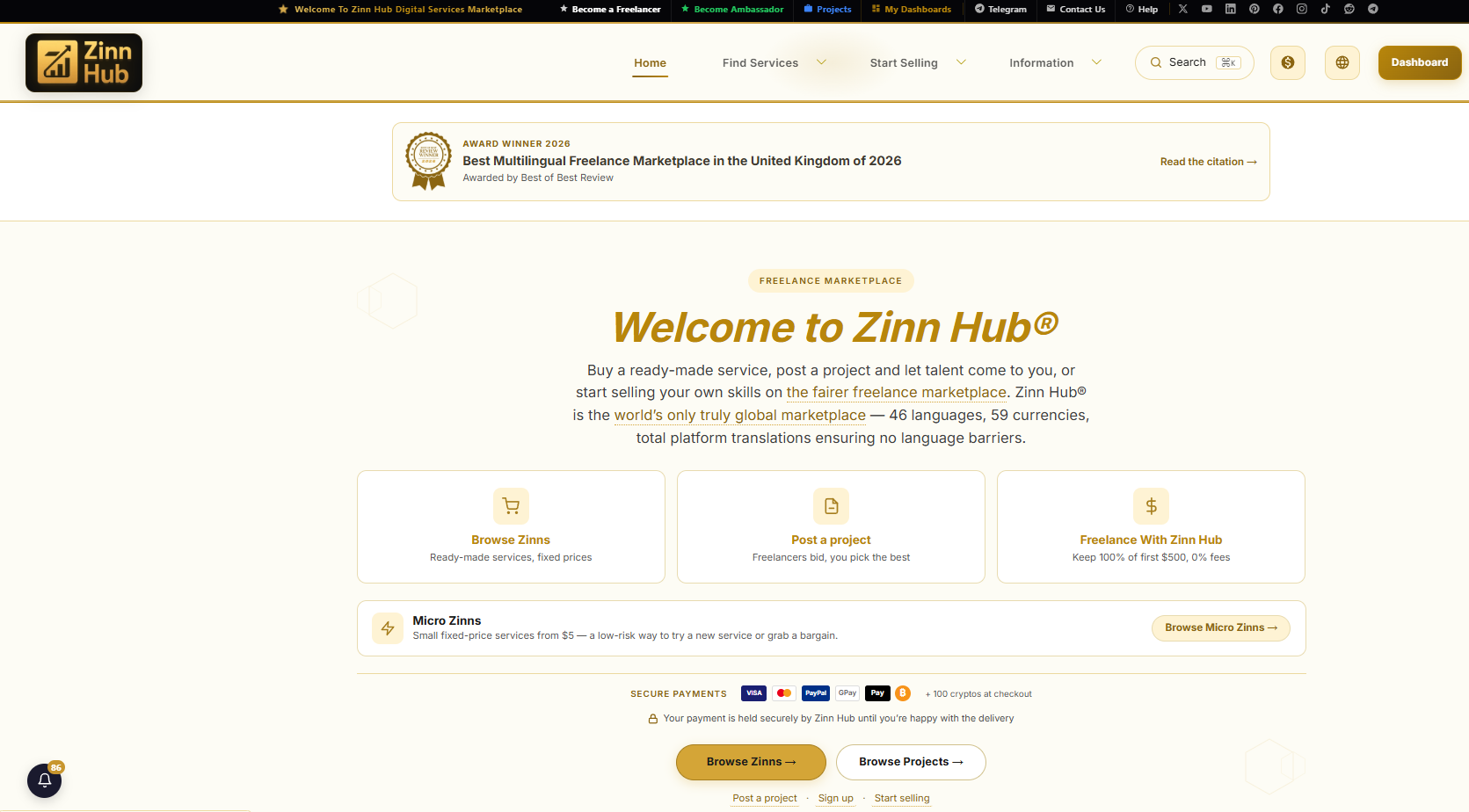
Zinn Hub® gives buyers several ways to find and hire freelance talent.
Zinns® are ready-made freelance services with a defined scope and price.
Micro Zinns® are smaller services designed for quick tasks or for buyers who want to try a freelancer with a lower-cost piece of work.
Projects allow buyers to describe a specific requirement and receive proposals from freelancers.
The Freelancer Directory allows buyers to browse freelancer profiles and invite suitable Zinners® to work with them.
Zinn Hub® supports 46 languages and 59 currencies, with multilingual tools across the marketplace, plus live call captions and spoken translation. This is designed to make it easier for buyers and freelancers to work together across languages.
Freelancers complete identity verification and provide evidence of their skills or previous work before selling or bidding, giving buyers additional information when deciding who to work with.
There is also no buyer platform fee, so the price shown to a buyer is the price they pay for the service or project, subject to any applicable payment-provider charges.
Final thoughts
Hiring a freelancer can give a business access to specialist skills, additional capacity and outside expertise without every requirement having to become a permanent position.
For some businesses, the biggest benefit is flexibility. For others, it may be access to a specialist they could not easily find locally, or simply getting an important project moving without waiting for a lengthy recruitment process.
The key is to match the hiring approach to the work that actually needs to be done.
Zinn Hub® provides several ways to do that, whether you need a ready-made service, a small task, proposals for a specific project or a freelancer with particular experience.